
5 Best Laser Firearm Training System for Home Use
The Strikeman 9mm Dry-Fire Laser Training System is the best laser firearm training system for most buyers because it pairs a 9mm laser cartridge with guided app drills and shot tracking. It offers a practical way to practice trigger control and sight alignment without live ammunition, range fees, or bulky equipment.
This guide is for new shooters, experienced owners, and anyone building a home practice routine. The key factors are cartridge fit, app compatibility, target setup, feedback quality, and battery life. A compact kit with clear scoring can make practice easier, but phone placement and room lighting still affect the experience. The five picks below are ranked by their strengths, with clear reasons and honest drawbacks for each.
Quick Comparison
| # | Product | Best For | Price | |
|---|---|---|---|---|
| 1 | Strikeman 9mm Dry-Fire Laser Training System | App-guided pistol practice | ~$125 | View → |
| 2 | Mantis Laser Academy Training Kit | Multi-drill shooting skill building | ~$159 | View → |
| 3 | ROTSGNEE 9mm Training Cartridge Laser Target | Budget 9mm trigger practice | ~$60 | View → |
| 4 | VNSH Laser Strike Training System | Realistic laser strike sessions | ~$99 | View → |
| 5 | 3rd Generation Dry Fire Training System | Advanced dry-fire progression | ~$36 | View → |
5 Laser Training Systems Worth Considering
These laser training systems are ranked in order, counting down to the top pick for different shooting needs.
5. 3rd Generation Dry Fire Training System

Best for: Compact home dry-fire practice
This digital laser target adds sound and hit counting to compatible laser training systems. It works with many dry-fire training cartridges in 9mm, .22 LR, and .223. The target accepts Class IIIA laser trainers rated below 5mW, so buyers should confirm their cartridge and laser match those limits. A front LED display shows hit counts, while sensor indicators help confirm each strike.
The target measures 3.54 by 3.54 by 1.15 inches, or 90 by 90 by 29.3mm. At a listed 5 ounces, it fits easily into a range bag or desk drawer. Its glass-fiber body supports a compact setup for home, office, or other small spaces. A strong magnet and a 3/8″-16 UNC threaded mount provide two placement options. The USB Type-C port recharges the unit, and separate lighting and volume controls allow quieter practice. At around $36, it costs more than a basic passive target but adds useful electronic feedback.
Pros
- Audio feedback confirms laser hits without checking the target after every shot.
- Rechargeable USB Type-C power avoids disposable batteries during practice sessions.
- Magnetic and 3/8″-16 mounting options support walls, tables, or compatible brackets.
Cons
- It only works with compatible Class IIIA lasers below 5mW and suitable training cartridges.
- The 3.54-inch target face gives less aiming area than a full-size paper target.
4. VNSH Laser Strike Training System
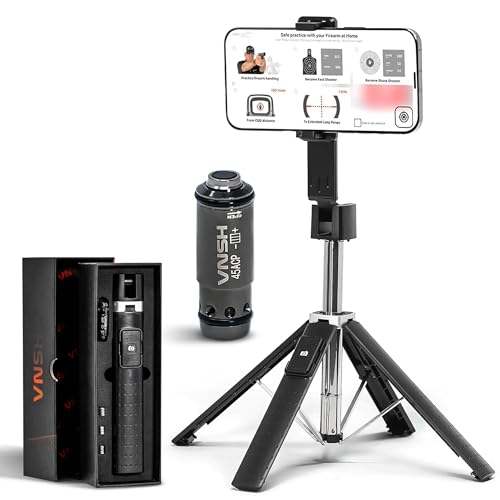
Best for: at-home 9mm dry-fire practice
The VNSH Laser Strike Training System uses a 9mm laser cartridge to help firearm owners practice trigger control without firing live ammunition. Pressing the trigger activates a visible laser point, allowing shooters to compare their aim against a compatible target. The listed practice range runs from 5 yards to 100 yards, so it can support close-range drills and longer-distance aiming work.
Its main advantage is immediate visual feedback without range fees, ammunition costs, or added barrel fouling. The cartridge uses an LR626 battery and can be set up at home, though users should follow strict dry-fire safety procedures and confirm the firearm is unloaded first. VNSH lists the system as compatible with 9mm pistols and also mentions multiple calibers, so buyers should verify fit before ordering. Around $99, it costs more than simple snap caps, but it adds laser-based aiming feedback. It will not reproduce recoil, muzzle movement, or the sound of a live shot.
Pros
- Provides instant laser feedback after each trigger press.
- Supports practice distances from 5 yards to 100 yards.
- Reduces live-ammunition use, range visits, and barrel fouling.
Cons
- The LR626 battery requires replacement and may limit practice if it runs low.
- It cannot simulate recoil, muzzle blast, or other live-fire effects.
3. ROTSGNEE 9mm Training Cartridge Laser Target

Best for: Quiet 9mm home practice
The ROTSGNEE system combines a 9mm laser training cartridge with a compact electronic target, so buyers do not need to match separate components. The target offers five difficulty levels, with scoring areas measuring 55mm, 40mm, 27.7mm, 16.8mm, and 8.5mm. Four extra center covers add more ways to tighten your aim. The cartridge uses a Class 3R laser rated below 5mW, with a 650nm wavelength and a claimed range of 15 to 100 yards.
Its strongest feature is quiet, flexible practice. Brightness and volume controls help adjust the target for different rooms, while silent mode suits apartments and late-night sessions. A built-in rechargeable battery charges through USB-C and includes low-battery and charging indicators. Setup options include built-in magnets for steel surfaces, a tabletop stand, wall mounting, and a standard 1/4-inch tripod thread. At around $60, it costs more than a basic laser cartridge, but includes the matching target.
Pros
- Five target sizes create a clear progression from broad practice areas to an 8.5mm center.
- Silent mode, brightness control, and rechargeable power support discreet indoor sessions.
- Magnets, a stand, wall mount, and tripod thread allow flexible placement.
Cons
- This kit is designed for 9mm firearms, so owners of other calibers need a different cartridge.
- Laser visibility can vary with room lighting and distance, despite the listed 15-to-100-yard range.
2. Mantis Laser Academy Training Kit

Best for: Indoor 9mm dry-fire practice
The Mantis Laser Academy Training Kit turns unloaded 9mm practice into a scored phone-based session. Its laser cartridge emits a Class IIIa, 3.5mW beam with each trigger pull. The included app tracks shot timing, placement, and session history without a subscription. Around $159, it costs more than basic snap caps, but it offers far more feedback than practicing trigger presses alone.
The kit includes 5-inch by 7-inch and 8-inch by 11-inch smart targets, five target stands, a mini tripod, a large tripod, and a smartphone holder. Phone shades help control glare, while the carrying case keeps the parts together. Guided drills, quizzes, videos, and friend-based scoring add structure to practice. The extraction stick is useful when removing the cartridge after a session. You still need a compatible phone or tablet, and all firearm safety procedures remain essential.
Pros
- Real-time scoring shows shot placement and trigger timing after each pull.
- Five stands and two target sizes support different indoor layouts.
- Free app access includes guided drills, history tracking, and quizzes without monthly fees.
Cons
- Dry fire cannot reproduce recoil, muzzle movement, or the sound of live ammunition.
- Practice depends on a compatible phone or tablet, careful target placement, and a clear camera view.
1. Strikeman 9mm Dry-Fire Laser Training System

Best for: Indoor 9mm dry-fire practice
The Strikeman 9mm Dry-Fire Laser Training System uses a laser cartridge instead of live ammunition. The kit includes a phone mount with tripod and a three-piece target that can hang on a wall or stand by itself. Around $125, it offers a lower-cost way to practice at home without range fees, noise, or projectile damage.
The updated Strikeman app tracks laser hits in real time and provides practice metrics, rapid-fire detection, and timer options. Basic app access does not require a subscription. Sound effects can be turned on, but the cartridge itself makes no noise. The system may help with sight alignment, trigger control, and draw practice, though it cannot recreate recoil or the full feel of live fire. Follow strict firearm safety rules, since this is a training accessory only. When installed, the device prevents normal operation of the firearm.
Pros
- Includes the 9mm laser cartridge, phone holder, tripod, and freestanding or wall-mounted target.
- App feedback records hits and supports timers, rapid-fire drills, and progress tracking.
- Quiet indoor practice avoids ammunition costs, range fees, and projectile damage.
Cons
- Dry fire cannot reproduce recoil, muzzle report, cycling, or live-fire handling.
- Requires a compatible smartphone and app setup, and buyers using another caliber may need a different cartridge.
Buying Guide
Compatibility with your firearm is the most important factor. A laser cartridge that does not match the chamber, action, or trigger behavior cannot provide useful practice.
- Firearm fit: Choose the exact cartridge or accessory size, such as 9mm Luger, .45 ACP, .223 Remington, or 12 gauge. Confirm the model and generation, not just the caliber.
- Trigger and reset support: For repeated dry-fire drills, choose a system that detects each trigger press and supports reset practice. A 10-minute session should record individual shots without manual rearming.
- App and target features: Check iOS or Android support, shot timers, scoring, and saved session history. At least 3 drill types and exportable results make progress easier to track.
- Laser visibility and safety: Red lasers are easier to see indoors, while infrared requires compatible equipment. Look for published eye-safety information, and never aim at people, animals, or reflective surfaces.
- Power and total cost: Prefer replaceable batteries or at least 2 hours of stated active use. Compare the full price, including the cartridge, target, app fee, and spare batteries. Many systems cost about $50 to $300.
If you cannot have everything, prioritize exact firearm compatibility before app features or extra targets.
Frequently Asked Questions
What is a laser firearm training system?
A laser firearm training system uses a laser emitter or laser-equipped replica to show where a shot would land without firing live ammunition. Many models pair with paper targets or phone apps, and some register hits from several feet away.
How does laser-based firearm practice work?
Laser-based firearm practice works by sending a brief light pulse toward a target when the trigger is pressed. The target, camera, or app then marks the estimated impact point, letting you review aim and trigger control without consuming cartridges. A common setup uses a 10-second drill timer.
Can laser training tools improve shooting practice?
Laser training tools can improve shooting practice by giving immediate visual feedback on aiming and trigger movement. They cannot replace live-fire training, recoil practice, or instruction from a qualified professional. For example, a user might complete 20 dry-fire repetitions, then confirm progress at a supervised range.
Are laser firearm simulators safe to use at home?
Laser firearm simulators are generally suitable for home practice when users follow firearm safety rules and treat every gun as loaded. Keep the muzzle pointed in a safe direction, remove live ammunition from the room, and use a backstop for physical targets. A 10-foot clear practice lane can help. Check the laser class, and never aim it at anyone’s eyes.
Conclusion
The Strikeman 9mm Dry-Fire Laser Training System is the strongest fit for handgun owners who want guided practice at home without live ammunition. If your priority is broader caliber support or a lower upfront cost, choose a modular laser cartridge kit instead, but confirm that its app and inserts match your firearm. Before buying, double-check the trainer’s size, firearm compatibility, cartridge quantity, and current price, since package contents and discounts can change. Dry-fire tools work best with a stable target, a safe direction, and an unloaded firearm during every session. Choose a setup you can use regularly, store safely, and understand without extra guesswork. Check local laws and manufacturer guidance before training.