
7 Best Battery Charger for ATV for Quick Trail Repairs
The NOCO GENIUS1 Smart Battery Charger is my top pick for most buyers and the best battery charger for atv because its automatic charging and maintenance mode makes battery care simple. Its 1-amp output suits slow charging and storage maintenance, while support for 6-volt and 12-volt batteries gives it broader use than a single-purpose tender.
This guide is for ATV owners replacing a lost charger or choosing one for seasonal storage. The key checks are battery compatibility and charging output, since the wrong voltage can damage a battery and a low-current unit takes longer to recharge. Cable length, weather protection, and connector style also affect daily use. The seven picks below are ranked with clear reasons and honest drawbacks for each, so you can match the charger to your ATV, battery type, and storage routine.
Quick Comparison
| # | Product | Best For | Price | |
|---|---|---|---|---|
| 1 | NOCO GENIUS1 Smart Battery Charger | Compact battery owners | ~$30 | View → |
| 2 | NOCO GENIUS2 Smart Battery Charger | Higher-capacity battery maintenance | ~$47 | View → |
| 3 | Battery Tender Junior 12V Charger and Maintainer | Motorcycle storage maintenance | ~$40 | View → |
| 4 | Unocho 6V/12V Battery Charger Maintainer | Mixed-voltage battery households | ~$20 | View → |
| 5 | MOTOPOWER MP00205A Battery Charger and Maintainer | Diagnostic-minded vehicle owners | — | View → |
| 6 | Foval 12V Automatic Trickle Battery Charger | Seasonal car storage | ~$17 | View → |
| 7 | Battery Tender Plus 12V Battery Charger and Maintainer | Frequent car battery maintainers | ~$59 | View → |
7 Top ATV Battery Charger Picks
The seven ATV chargers below are ranked by charging features, battery compatibility, safety controls, and value, counting down to the top pick.
7. Battery Tender Plus 12V Battery Charger and Maintainer

Best for: Seasonal vehicle battery maintenance
The Battery Tender Plus is a 12-volt charger and maintainer rated at 1.25 amps. It is designed for cars, motorcycles, ATVs, and lawn mowers that sit unused between rides or seasons. Instead of supplying a fixed trickle, its charging system adjusts output as the battery needs power, then switches into float maintenance. A four-step charging cycle supports battery health without constant manual monitoring.
The package includes two connection choices: a fused ring-terminal harness for a semi-permanent setup and alligator clips for temporary use. A quick-disconnect plug makes switching between storage and driving simpler. The two-color solid-state LED shows charge status, and charging resumes at full output if voltage falls too low under load. Around $59, it costs more than basic trickle chargers, but the included cables, 10-year warranty, and lifetime customer support add value for long-term seasonal use.
Pros
- The 1.25-amp adaptive program charges and maintains 12V vehicle batteries.
- Ring terminals and alligator clips support permanent or temporary connections.
- The LED gives a quick view of charging status and battery voltage recovery.
Cons
- The 1.25-amp output is intended for maintenance, not fast charging heavily depleted batteries.
- The two-color LED provides less diagnostic detail than a charger with a digital display.
6. Foval 12V Automatic Trickle Battery Charger
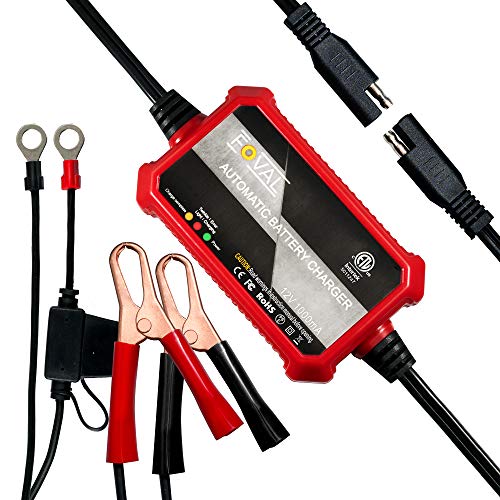
Best for: Maintaining 12V lead-acid batteries
The Foval Automatic Trickle Battery Charger is a compact 12V, 1A charger for lead-acid batteries. It supports SLA, VRLA, gel, AGM, and wet-cell batteries found in cars, motorcycles, lawn equipment, boats, ATVs, and RVs. Its four-step program moves from initialization to bulk charging, absorption, and float maintenance. After charging, it switches to a lower maintenance voltage instead of continuously pushing full power. At around $17, it offers a practical option for seasonal vehicles and equipment.
This unit measures 3.9 by 2.4 by 1.25 inches and weighs 10.5 ounces. The combined AC and DC cable length reaches 102 inches, which gives some flexibility around a vehicle or garage outlet. Two removable output leads are included, one with ring terminals and one with alligator clips. LED combinations show power, charging, and full-charge status, although they do not provide an exact battery percentage. The ABS flame-retardant housing and built-in protection cover reverse polarity, over-current, overload, and over-voltage conditions. Foval also includes an 18-month warranty.
Pros
- Supports several 12V lead-acid battery types, including AGM, gel, and wet-cell models.
- Four-step charging can maintain batteries during storage without constant manual adjustment.
- Compact body, 102-inch cable reach, and two connector styles suit garage use.
Cons
- The 1A output can charge large car, truck, or RV batteries slowly.
- It is not designed for lithium batteries or other non-lead-acid chemistries.
5. MOTOPOWER MP00205A Battery Charger and Maintainer

Best for: Seasonal 12V vehicle battery care
The MOTOPOWER MP00205A is a 12-volt automatic charger, maintainer, trickle charger, and desulfator. Its 800mA output suits lead-acid batteries, including flooded, sealed maintenance-free, AGM, and gel-cell types. It connects directly to the battery, then manages charging without manual adjustments. The unit also uses pulse current to address sulfation during its charging cycle.
Its safety system adds useful protection for long-term battery care. The charger stops its main charging stage at up to 14.4 volts, then maintains the battery at 13.6 volts. A built-in 24-hour timer moves the unit into maintenance mode when voltage rises above 14 volts. Reverse-polarity, short-circuit, and overcharge protection cover common connection mistakes. It produces no output in standby and is designed to avoid sparks when the leads connect. The main trade-off is speed. At 800mA, it fits maintenance and gradual recovery better than quick charging.
Pros
- Supports 12-volt flooded, sealed, AGM, and gel-cell lead-acid batteries.
- Automatic pulse desulfation works without a separate setting or manual cycle.
- Maintains at 13.6 volts and includes a 24-hour timer for extended connection.
Cons
- The 800mA output can take a long time to recharge a heavily drained battery.
- It is designed for 12-volt lead-acid batteries, not 6-volt or lithium models.
4. Unocho 6V/12V Battery Charger Maintainer

Best for: Seasonal lead-acid battery storage
The Unocho is a compact 1.5A charger and maintainer for 6V and 12V lead-acid batteries. It supports SLA, AGM, GEL, VRLA, WET, and deep-cycle types used in cars, motorcycles, lawn mowers, boats, ATVs, RVs, scooters, golf carts, and snowmobiles. At around $20, it targets basic garage and seasonal-storage needs.
Its five charging stages include battery detection, soft start, bulk charging, absorption, and float maintenance. That automatic process can keep a compatible battery ready without continuous manual adjustment. Reverse-polarity, short-circuit, over-voltage, over-current, overload, and thermal protection add useful safeguards. A 72-hour timer and inline 10A fuse provide extra control. The detachable alligator clips and ring terminals connect through an SAE quick disconnect, while LED indicators show charging, full-charge, and maintenance status. The 1.5A output is gentle, but larger batteries may take substantial time to charge.
Pros
- Supports both 6V and 12V lead-acid batteries, including AGM, GEL, SLA, VRLA, and WET types.
- Includes alligator clips and ring terminals with an SAE quick disconnect for flexible connections.
- Offers multiple safety systems, including thermal protection, reverse-polarity protection, a 72-hour timer, and a 10A fuse.
Cons
- It is designed for lead-acid batteries, not lithium battery packs.
- The 1.5A output may charge large deep-cycle or automotive batteries slowly.
3. Battery Tender Junior 12V Charger and Maintainer

Best for: Seasonal motorcycle and ATV storage
This compact automatic charger is built for 12-volt powersports batteries, including lead-acid, flooded, AGM, and gel cell types. It supplies 750 milliamps, fills the battery through bulk and absorption stages, then shifts to float mode for long-term storage. That makes it more controlled than a basic trickle charger, which can keep pushing current without the same charge-cycle management. At around $40, it costs more than simple plug-in maintainers, but the broader battery compatibility adds value for owners with several machines.
The charger measures 3.3 by 1.3 by 2.4 inches and weighs 1 pound, so it can fit on a crowded garage shelf. A 12-foot output cable helps reach batteries in cramped frames or storage areas. The package includes a fused ring-terminal harness and an alligator-clip cable, giving you both a semi-permanent connection and a quick temporary option. A two-color LED reports charging status, while reverse-connection detection and spark-proof circuitry make hookup safer. It also includes a five-year warranty and lifetime customer support.
Pros
- Four charging stages help maintain proper voltage during storage.
- Twelve-foot cable reaches batteries in tight motorcycle and ATV frames.
- Ring terminals and alligator clips support permanent or temporary hookups.
Cons
- The 750mA output charges slowly, especially on larger batteries.
- It only supports 12-volt batteries, not 6-volt systems.
2. NOCO GENIUS2 Smart Battery Charger

Best for: Seasonal cars, motorcycles, and boats
The NOCO GENIUS2 is a 2-amp smart charger for 6-volt and 12-volt batteries. It works with common lead-acid types, including flooded, gel, and AGM batteries, plus marine, deep-cycle, and lithium-ion batteries. Its compact housing fits smaller storage areas, while automatic charging adjusts to the battery’s needs instead of running at one constant rate. At around $47, it costs more than basic plug-in maintainers, but it covers more battery types.
A useful feature is Force Mode, which lets you manually start charging a battery that has dropped below the charger’s normal detection range, even down to 0 volts according to the manufacturer. That feature requires care, since a severely discharged or damaged battery may not be safe to recharge. Temperature compensation changes the charging cycle for warmer or colder conditions. The charger also checks and reconditions the battery every 24 hours, then maintains it automatically to help prevent overcharging during storage.
Pros
- Supports 6V and 12V lead-acid, AGM, gel, marine, deep-cycle, and lithium-ion batteries.
- Force Mode can begin charging batteries that automatic sensing cannot detect.
- Automatic maintenance includes a 24-hour reconditioning cycle and temperature adjustment.
Cons
- The 2A output charges large batteries slowly compared with 6A or 10A chargers.
- Force Mode requires manual use and should not replace inspection of a damaged battery.
1. NOCO GENIUS1 Smart Battery Charger

Best for: Owners maintaining cars, motorcycles, and boats
The NOCO GENIUS1 is a compact 1A charger and battery maintainer for 6V and 12V batteries. It supports lead-acid types such as AGM, gel, SLA, VRLA, flooded, maintenance-free, deep-cycle, and marine batteries. It also works with LiFePO4 lithium batteries. At around $30, it fits owners who need a small charger for a car, motorcycle, lawn mower, ATV, boat, or RV.
Its temperature sensor adjusts charging for hot and cold conditions, which helps reduce overcharging or undercharging. The unit can begin with batteries at 1V, while Force Mode can apply a charge to batteries reading 0V. Pulse charging targets sulfation and acid stratification, though it cannot repair every aged or physically damaged battery. The charger can remain connected for long-term maintenance after the battery reaches full charge. The box includes a wall plug, 110-inch DC cable, clamps, and integrated eyelet terminals. A three-year warranty adds useful coverage, but the 1A output makes this a slow charger for larger batteries.
Pros
- Supports both 6V and 12V lead-acid and LiFePO4 batteries.
- Temperature compensation adjusts charging as ambient conditions change.
- Includes clamps and eyelet terminals for temporary or semi-permanent connections.
Cons
- 1A output takes a long time to charge large car, truck, RV, or marine batteries.
- Force Mode requires manual use, and deeply damaged batteries may not recover.
Buying Guide
Match the charger to your ATV battery’s voltage and chemistry first. A 12-volt lead-acid charger may damage a lithium battery, while the wrong output can leave a battery undercharged or shorten its life.
- Battery compatibility: Confirm support for 12-volt AGM, gel, flooded lead-acid, or lithium batteries. Choose a lithium-compatible model if your ATV uses an LiFePO4 battery.
- Charging rate: Pick 0.75 to 2 amps for routine maintenance on most ATV batteries. A 4-amp setting can charge faster, but small batteries may heat up or wear sooner.
- Automatic operation: Look for automatic shutoff, float mode, or a maintenance setting. These features let the charger stay connected for weeks without constant monitoring.
- Safety features: Require reverse-polarity protection, short-circuit protection, and spark reduction. A charger with an IP65 rating suits dusty garages and occasional moisture better than an indoor-only model.
- Connections and price: Choose a unit with 4 to 6-foot leads, ring terminals, and alligator clips. Basic maintainers cost about $20 to $40, while multi-mode chargers often cost $40 to $90.
If you cannot prioritize everything, choose correct voltage and battery chemistry compatibility before charging speed or extra accessories.
Frequently Asked Questions
How do I choose an ATV battery charger?
Choose an ATV battery charger by matching its voltage, battery type, and charging current to your machine. A 12-volt lead-acid battery usually needs a smart charger rated for 12 volts, while lithium batteries require a lithium-compatible model. For small ATV batteries, a 0.75-amp to 2-amp maintainer is often sufficient.
What size charger should I use for an ATV battery?
A 1-amp to 2-amp charger is usually the right size for maintaining an ATV battery, while a 4-amp to 6-amp unit can recharge a deeply drained battery faster. Check the battery label before buying, since a 12-volt battery and a 6-volt battery need different charger settings and connectors.
Can I leave an ATV battery maintainer connected overnight?
Yes, you can leave a smart charger connected to an ATV battery for extended periods, provided it has automatic shutoff or float mode and matches the battery chemistry. Many maintainers switch to a low-current float setting after charging, such as 0.5 amp, but inspect the manual and keep connections dry.
Are automatic ATV chargers better than basic chargers?
Automatic ATV chargers are generally safer and more convenient than basic plug-in chargers because they stop or reduce current when the battery reaches full charge. A model with reverse-polarity protection and a 12-volt setting adds useful protection, especially when the battery remains connected during winter storage.
Conclusion
The NOCO GENIUS1 Smart Battery Charger is the top recommendation for ATV owners who want a compact, automatic charger for one battery. Its simple controls and battery-maintenance function make it a practical choice for seasonal machines, stored ATVs, and riders who prefer a set-it-and-check-it routine. If your priority is maintaining several batteries at once, choose a multi-bank charger instead, since it can service multiple batteries without moving one set of leads between machines. Before buying, double-check the charger’s physical size, ATV battery compatibility, package quantity, and current price, since listings can vary by seller and configuration. Also confirm the charger supports your battery’s voltage and chemistry, then keep the receipt and instructions with your maintenance supplies.