
7 Best Backpacking Knife Sharpener for Lightweight Packs
Smith’s CCKS 2-Step Knife Sharpener is the best backpacking knife sharpener for most buyers because its compact pull-through design gives you quick edge repairs without taking much pack space. Its two-stage setup uses carbide and ceramic surfaces, so it can restore a dull blade and refine the edge in a few passes.
This guide is for hikers, campers, and hunters who need a simple tool for field maintenance. The key factors are overall size, carry weight, sharpening materials, and how easily each model works on common outdoor knives. The 7 picks below are ranked by practical value, with clear reasons and honest drawbacks for each.
Quick Comparison
| # | Product | Best For | Price | |
|---|---|---|---|---|
| 1 | Smith's CCKS 2-Step Knife Sharpener | Best For Budget-Conscious Kitchen Users | ~$7 | View → |
| 2 | Work Sharp Guided Field Sharpener | Best For Backcountry Blade Maintenance | ~$40 | View → |
| 3 | Work Sharp WSGPS-W Portable Knife Sharpener | Best For Portable Precision Sharpening | ~$15 | View → |
| 4 | Work Sharp EDC Pivot Plus Knife Sharpener | Best For Everyday Carry Knives | ~$15 | View → |
| 5 | 4-in-1 Kitchen Knife Sharpener with Cut-Resistant Glove | Best For Safety-Focused Home Cooks | ~$13 | View → |
| 6 | Gerber Edgefield Knife Sharpener | Best For Simple Outdoor Touch-Ups | ~$13 | View → |
| 7 | AIERLIAN Rolling Knife Sharpener | Best For Consistent Rolling Sharpening | ~$40 | View → |
7 Top Backpacking Sharpener Picks
These compact sharpeners are ranked by packability, sharpening control, and durability, counting down to the top pick.
7. AIERLIAN Rolling Knife Sharpener

Best for: home cooks maintaining straight-edge knives
The AIERLIAN rolling sharpener uses a wooden base, magnetic angle guides, and two abrasive discs. Its #400 diamond disc removes worn metal from a dull edge, while the #3000 ceramic disc smooths and polishes it. A leather strop follows those steps, helping remove fine burrs and refine the edge. The kit costs around $40, though prices can change.
Four N42 magnets hold the knife against the support as you roll the sharpener along the blade. The guide offers 20 degrees for most household knives and 15 degrees for a thinner, sharper edge. That fixed-angle setup makes the process more repeatable than freehand sharpening. It also reduces guesswork for users who do not sharpen knives often. Still, the tool requires several passes and careful pressure. It is made for straight-edged steel knives, not every blade type.
Pros
- The #400 diamond and #3000 ceramic discs cover both edge repair and polishing.
- Four N42 magnets help keep the knife positioned during sharpening.
- The included leather strop can reduce fine burrs after honing.
Cons
- The 15- and 20-degree settings do not support custom angles.
- It is not suitable for serrated knives or scissors, so a separate sharpener may be needed.
6. Gerber Edgefield Knife Sharpener

Best for: Campers carrying folding knives
The Gerber Edgefield is a compact sharpener for camping kits, toolboxes, and everyday carry. Its rotating core includes a 220-grit coarse diamond surface, a 600-grit fine diamond surface, and a ceramic rod for final honing. That gives you two levels of material removal plus a finishing stage in one tool. At around $13, it is an inexpensive way to maintain a useful pocketknife away from home.
The Edgefield measures 7.1 inches long, is less than 1 inch wide, and weighs under 3 ounces. It should fit easily into a pack, tackle bag, or work pouch without taking much space. An angle guide helps keep each pass consistent, while stabilized feet provide a steadier base during use. The protective closure also covers the sharpening core between jobs. Its main strength is versatility in a small package. It can refresh a dull edge, refine it, and hone the finish without carrying separate stones. The compact design does favor light maintenance over heavy blade repair.
Pros
- Combines 220-grit coarse and 600-grit fine diamond sharpeners.
- Includes a ceramic rod for final honing.
- Lightweight body, protective closure, and angle guide suit field use.
Cons
- Under 3 ounces, it may feel less stable than a larger countertop sharpener.
- The compact format is better for routine touch-ups than heavily damaged blades.
5. 4-in-1 Kitchen Knife Sharpener with Cut-Resistant Glove
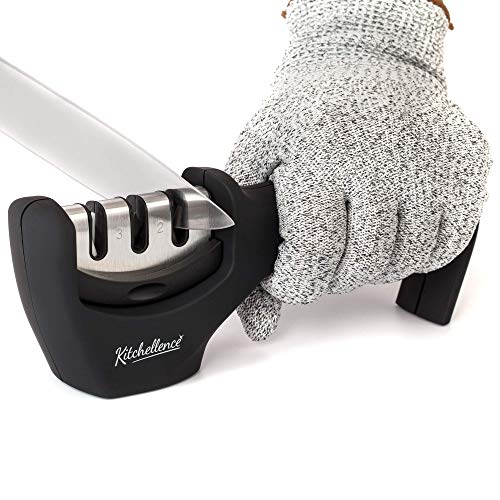
Best for: Home cooks maintaining everyday kitchen knives
This 4-in-1 kitchen kit combines a three-stage pull-through sharpener with a cut-resistant glove. The sharpener uses a diamond slot first to repair and straighten damaged edges. The second slot restores the blade’s V-shaped edge, while the third slot fine-tunes and polishes it. You pull the knife through each opening a few times, rather than managing a separate sharpening stone. Its ABS plastic body has an ergonomic handle for right- or left-handed use, plus a non-slip base for steadier countertop control.
The setup is simple for routine knife care, especially when a blade feels dull but does not need professional service. The included glove adds hand protection during sharpening, although it should not replace careful knife handling. At around $13, this kit costs less than many standalone sharpeners, and the four-piece format includes the main tool plus the glove. The pull-through design can save space and reduce the learning curve, but it gives you less control than manual stones or guided systems. It is best suited to ordinary kitchen knives and basic edge maintenance.
Pros
- Three sharpening stages handle repair, edge shaping, and final polishing.
- Non-slip base and ergonomic handle support controlled, two-handed use.
- Included cut-resistant glove adds a layer of hand protection.
Cons
- Pull-through slots offer less sharpening control than whetstones.
- The product does not specify glove size or the blade types it supports.
4. Work Sharp EDC Pivot Plus Knife Sharpener
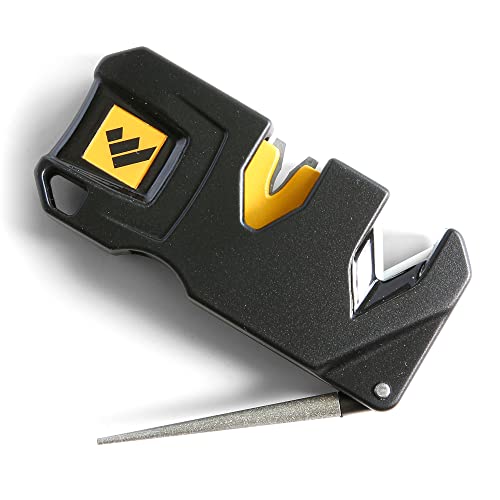
Best for: Quick knife maintenance away from home
The Work Sharp EDC Pivot Plus is a compact, handheld sharpener for routine knife upkeep. Its carbide inserts quickly form a convex edge on many knife steels, while the pivoting design follows the blade’s curve. The system uses a 25° sharpening angle, helping maintain a consistent bevel from the heel to the tip.
A ceramic hone handles quick touch-ups after sharpening, and a tapered rod with medium-grit diamond coating works on serrations and narrow tools. That combination gives this small sharpener more range than a basic pull-through model. At around $15, it also costs little to keep in a kitchen drawer, glove box, or outdoor kit. The trade-off is a simple, fixed setup rather than a full sharpening system with multiple angle choices or replaceable stones.
Pros
- Convex-carbide inserts restore dull edges quickly across many knife steels.
- Pivoting carbide guides follow curved blades at a 25° angle.
- Ceramic and diamond tools cover touch-ups, serrations, and fine-edge tools.
Cons
- The fixed 25° angle may not suit knives designed for another bevel angle.
- Carbide sharpening removes more metal than careful stone sharpening, so it is better for maintenance than fine edge refinement.
3. Work Sharp WSGPS-W Portable Knife Sharpener

Best for: Hunters needing field-ready edge maintenance
The Work Sharp Portable Pocket and Hunting Knife Sharpener is a compact two-stage tool for knives used at home, in a workshop, or outdoors. Its 320-grit diamond plate removes enough metal for routine edge repairs, while the fine ceramic rod smooths the edge afterward. The diamond side guides the blade at 20 degrees, and the ceramic side uses a 25-degree guide. Those fixed angles make the process more repeatable than freehand sharpening, especially for users who do not sharpen often.
Its self-contained design needs no assembly, loose parts, or setup before use. That makes it practical for a hunting pack, tackle box, tool drawer, or kitchen cabinet. The small format also limits how much sharpening surface you get, so it is better suited to pocket knives and hunting blades than large kitchen knives. Around $15, it offers a low-cost way to maintain a useful edge. Work Sharp is a fourth-generation family-owned company based in Ashland, Oregon, with more than 40 years of sharpening-tool experience.
Pros
- 320-grit diamond plate handles routine edge repairs and dull spots.
- Built-in 20-degree and 25-degree guides support more consistent sharpening.
- Self-contained construction requires no assembly and packs easily for field use.
Cons
- The fixed angles may not match every knife’s original edge bevel.
- Its compact sharpening surfaces are less suitable for large blades or major edge damage.
2. Work Sharp Guided Field Sharpener

Best for: Hunters, campers, and anglers
The Work Sharp Guided Field Sharpener is a compact manual tool for maintaining knives away from home. It combines diamond plates, ceramic honing surfaces, a leather strop, and guided sharpening angles in one self-contained unit. The guides support 20- and 25-degree edges, while five abrasive surfaces cover basic edge repair, honing, and polishing. No assembly or extra tools are needed.
Its most useful detail is the rotating ceramic rod. Turn it to access coarse or fine honing surfaces, plus a grooved section for sharpening fish hooks. The removable diamond plates also reveal a broadhead wrench, which adds practical value for bowhunters. Around $40, it costs more than a basic pocket sharpener, but it offers more functions in a small package. Work Sharp includes a three-year warranty, and the tool is designed and calibrated in Ashland, Oregon.
Pros
- Five abrasive surfaces handle sharpening, honing, and stropping in one tool.
- Removable diamond plates expose a broadhead wrench for field use.
- Rotating ceramic rod includes coarse, fine, and fish-hook surfaces.
Cons
- Its compact format means smaller sharpening surfaces than full-size bench systems.
- The 20- and 25-degree guides offer less angle range than more advanced sharpeners.
1. Smith’s CCKS 2-Step Knife Sharpener

Best for: Campers carrying pocket knives
This compact Smith’s sharpener uses two pull-through stages in a yellow plastic body. The coarse slot has crossed tungsten carbide blades for dull edges, while crossed ceramic rods refine knives that are already fairly sharp. Three to four passes through the carbide slot can restore a noticeably worn edge, then a few passes through the ceramic side can smooth it. Preset angles make the process simple, though they leave less room for personal sharpening preferences.
At 2.33 by 2.71 inches and under 2 ounces, the tool fits easily in a pocket, tackle box, or hunting pack. A lanyard hole lets you attach it to a keychain or backpack. Non-slip rubber feet help keep it steady, and the plastic body floats if dropped near a boat or stream. Around $7, it offers a low-cost way to maintain fillet, hunting, and pocket knives away from home.
Pros
- Two stages handle both dull-edge repair and routine touch-ups.
- Small, lightweight design fits packs, pockets, and tackle boxes.
- Floating body, rubber feet, and lanyard hole suit outdoor use.
Cons
- Preset sharpening angles give you little control over the edge angle.
- The coarse carbide slot can remove more metal than careful stone sharpening.
Buying Guide
For a backpacking knife sharpener, weight-to-performance ratio matters most. A tool under 3 ounces can restore a working edge without adding much bulk, but it still needs an abrasive suited to your blade.
- Weight and size: Choose a sharpener under 3 ounces and about 4 to 6 inches long. It should fit inside a hip-belt pocket or small repair pouch.
- Abrasive type: Diamond plates work well for quick field repairs. Select a 400- to 600-grit surface for damaged edges, or choose a two-sided model with 600 and 1,000 grit.
- Sharpening angle: Look for an angle guide between 15 and 20 degrees per side. This helps maintain the edge angle on thin outdoor knives.
- Grip and protection: A textured handle, finger guard, or folding design reduces slips. Include a cover or sleeve so the abrasive surface does not damage other gear.
- Knife compatibility: Check that the sharpener suits your blade steel and edge style. Ceramic rods help polish fine edges, while diamond surfaces handle harder steels and minor chips.
- Price and durability: Expect to pay $15 to $40 for a compact model with a steel or aluminum body. Avoid plastic housings that flex under firm pressure.
If you cannot have everything, prioritize low weight paired with a useful diamond grit.
Frequently Asked Questions
How do you choose a sharpener for backpacking?
A good backpacking sharpener should be compact, durable, and compatible with your knife’s edge. Look for a model under 4 ounces with diamond plates, ceramic rods, or both. A two-stage tool can handle routine touch-ups, while a small fixed-angle guide helps maintain consistent results outdoors.
What type of knife sharpener works best in the backcountry?
A pocket-sized diamond sharpener usually works best for backcountry repairs because it removes metal quickly and handles hard steels. Choose a rod or plate around 2 to 4 inches long, then pack a ceramic side for light finishing. Avoid bulky pull-through units that add weight and limit control.
Can a portable sharpener fix a badly dull camping knife?
A portable sharpener can restore a badly dull camping knife, but it may require several minutes and multiple passes. Coarse diamond surfaces remove damaged metal fastest, while fine ceramic surfaces refine the edge. For a chipped blade or bent tip, sharpening alone may not fully repair the damage.
Are mini knife sharpeners safe for outdoor knives?
Mini knife sharpeners are safe for outdoor knives when you use light pressure and follow the tool’s angle guide. Keep fingers behind the abrasive surface, sharpen away from your body, and inspect the edge after each pass. Many compact models use a 20-degree angle per side, but confirm the maker’s instructions.
Conclusion
Smith’s CCKS 2-Step Knife Sharpener is the top choice for hikers who want a simple, compact tool for routine blade touch-ups on the trail. If your priority is finer control or more sharpening options, choose a guided field sharpener with multiple abrasive surfaces instead. Before buying, double-check the tool’s size, compatibility with your knife’s edge style, package quantity, and current price. A sharpener should fit your repair kit without adding unnecessary bulk. It also needs to match the knives you carry, since some tools work better with plain edges than serrated ones. For occasional field maintenance, a two-step design keeps the process quick and easy. Pack it with a small cloth to protect nearby gear from metal dust.