
7 Best Hiking Gadgets for Safer Day Hikes
Atomic Bear Paracord Bracelet is the top pick for most buyers among the best hiking gadgets because it packs several basic emergency tools into a wearable design. It is a practical paracord bracelet with survival features for hikers who want a compact backup without carrying a separate kit. Its small footprint makes it easy to keep on your wrist, pack strap, or keyring, though it cannot replace a full first-aid or navigation setup.
This guide is for day hikers, campers, and anyone building a lighter emergency kit. For this kind of trail gear, size, cord material, and tool access matter most. A bracelet that feels bulky or difficult to use may stay packed when you need it. The 7 picks below are ranked with clear reasons and honest drawbacks for each, so you can match a useful accessory to your route, pack, and comfort needs.
Quick Comparison
| # | Product | Best For | Price | |
|---|---|---|---|---|
| 1 | Atomic Bear Paracord Bracelet | Hikers needing emergency cord | ~$13 | View → |
| 2 | FUNBRO Multitool Carabiner | Drivers needing compact tools | ~$10 | View → |
| 3 | LifeStraw Personal Water Filter | Solo backcountry hikers | ~$17 | View → |
| 4 | 8×42 Monocular Telescope | Wildlife spotters on day hikes | ~$31 | View → |
| 5 | HongyiTime Hand Washing Soap Sheets | Travelers avoiding liquid toiletries | ~$6 | View → |
| 6 | UST Tool-a-Long Multi-Tool Carabiner | Everyday carry tool users | ~$10 | View → |
| 7 | Coghlan's Compass Carabiner | Campers needing basic navigation | ~$9 | View → |
7 Trail Gadgets Worth Packing
The list is ranked by usefulness, durability, and packability, counting down to the top pick for trail-ready performance.
7. Coghlan’s Compass Carabiner

Best for: Casual hikers needing backup direction
Coghlan’s Compass is a small liquid-filled navigation tool for hiking, camping, backpacking, and basic orienteering. Its 1.2 x 2.7 x 0.4-inch body weighs just 0.6 ounces, so it adds little bulk to a daypack or emergency kit. The black aluminum construction should handle normal outdoor use better than a thin plastic case.
The built-in carabiner clips to a backpack strap, belt loop, or gear pouch for quick access. Liquid inside the housing helps the needle settle instead of swinging wildly with every movement. Luminous directional markers can provide a quick reference in dim conditions after receiving enough light, though they are not a substitute for a headlamp. At around $9, this compass offers a low-cost backup for marked trails, campsites, and basic land navigation. It is most useful alongside a map and phone or GPS, rather than as a complete navigation system by itself.
Pros
- Weighs only 0.6 ounces, making it easy to carry as a backup tool.
- Built-in carabiner keeps the compass accessible on a pack or belt.
- Liquid-filled design and luminous markers support quicker readings in motion and low light.
Cons
- Its compact face may be harder to read than a larger baseplate compass.
- The carabiner is for carrying gear, not technical climbing or load-bearing use.
6. UST Tool-a-Long Multi-Tool Carabiner
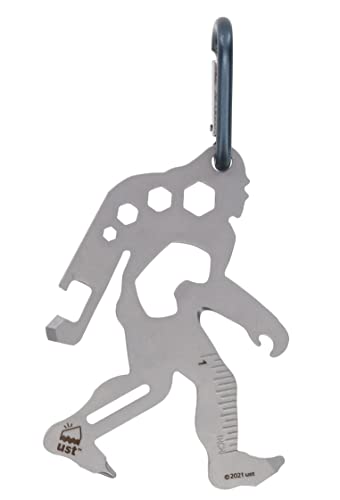
Best for: Backpackers wanting basic tools
The UST Tool-a-Long combines a small stainless steel multi-tool with a built-in carabiner. It measures 3.6 inches high, 2.5 inches wide, and only 0.1 inch deep. At 1.2 ounces, it adds little weight to a daypack, travel bag, or camp kitchen kit. The carabiner lets you clip it to compatible gear for quick access.
Eight functions cover simple tasks: a hex wrench, bottle opener, cord cutter, 1-inch ruler, flat-head screwdriver, Phillips screwdriver, butterfly wrench, and can opener. That mix suits basic repairs, opening containers, and cutting cord. Its stainless steel body should handle normal outdoor use better than a plastic tool. The TSA-compliant design also makes it a practical choice for travel, though airport decisions can vary by location and screening staff. Hand-wash care is required. At around $10, it offers a useful set of small tools without much bulk.
Pros
- Eight built-in functions cover common camp and travel tasks.
- Stainless steel construction provides a durable metal body.
- The 1.2-ounce size adds minimal weight to packed gear.
Cons
- The tools are small, so they may feel awkward for larger hands or stubborn fasteners.
- The carabiner has no stated load rating, so it should not replace climbing or safety hardware.
5. HongyiTime Hand Washing Soap Sheets

Best for: Campers needing compact hand soap
The HongyiTime set contains two small boxes, with 100 soap sheets in each box for 200 sheets total. Each paper-thin sheet dissolves in water, allowing you to rub your hands together and rinse away dirt. The packets fit easily into a travel bag, school backpack, picnic kit, or car console. At around $6, the set costs little compared with carrying a bottle of liquid soap.
These sheets use biodegradable plant extracts and leave a rose fragrance after washing. That makes them useful for camping, hiking, BBQs, parties, and other places where shared soap may be unavailable. The individual sheets also help control portions, so you do not need to squeeze out extra liquid. Still, the product requires access to water and a proper rinse. It is hand soap, not a dry cleaning solution or a replacement for sanitizer when washing facilities are unavailable.
Pros
- 200 total sheets provide a long supply for trips, school, or group events.
- Lightweight paper sheets take up less room than a liquid soap bottle.
- Biodegradable plant-based ingredients and rose fragrance offer a gentler-feeling wash.
Cons
- Each sheet needs water and rinsing, so it is not useful where a sink or clean water is unavailable.
- Rose fragrance may bother people who prefer unscented products or have fragrance sensitivity.
4. 8×42 Monocular Telescope

Best for: Casual outdoor viewing and travel
This compact monocular uses 8x magnification and a 42mm objective lens for a wide view of birds, wildlife, scenery, and sports. Its body measures about 5.7 by 1.9 by 1.5 inches, so it fits easily in a daypack or glove box. The optical system uses BAK-4 glass prisms and fully multi-coated lenses. The listed field of view reaches 360 feet at 1,000 yards, which should help when scanning open areas.
The rubber-armored shell adds grip and some protection against drops and rough handling. It is advertised as nitrogen-filled, waterproof, fogproof, dust-resistant, and shockproof, though those ratings are not given with an IP code or test standard. A twist-up eyecup supports use with glasses, and the included hand strap and carry case make transport easier. The bottom has a tripod connector for steadier views. At around $31, it offers a useful starter setup for casual outdoor use, but buyers should keep expectations realistic about image quality at this price.
Pros
- 8x power and a 42mm lens provide a broad viewing setup for wildlife and scenery.
- BAK-4 prisms and fully multi-coated optics can improve brightness and contrast.
- Hand strap, carry case, eyecup, and tripod mount add practical flexibility.
Cons
- The fixed 8x magnification gives less framing control than a zoom optic.
- “Low-light night vision” does not mean true infrared or full nighttime viewing.
3. LifeStraw Personal Water Filter
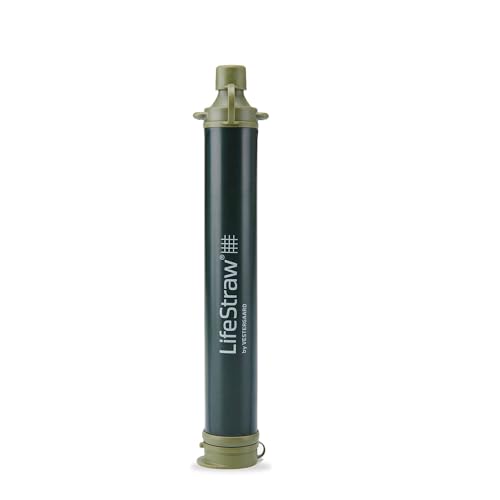
Best for: Backpackers needing emergency water
The LifeStraw Personal Water Filter is a compact, single-user straw for hiking, travel, and emergency kits. You drink directly from a stream, lake, or container instead of filling a bottle first. Its membrane is rated to remove 99.999999% of waterborne bacteria, including E. coli and Salmonella, along with 99.999% of parasites such as Giardia and Cryptosporidium.
It also removes microplastics down to 1 micron and reduces fine particles to 0.2 microns, according to the listed specifications. Laboratory testing follows protocols from the EPA, NSF, and ASTM. With proper use and maintenance, the filter is rated for up to 4,000 liters, or 1,000 gallons, of water. Around $17, it costs little to add one to a pack. Still, the protection targets bacteria, parasites, and microplastics. It is not a complete treatment for every possible contaminant, so water source choice still matters.
Pros
- Removes bacteria and parasites linked to common untreated water.
- Filters microplastics down to 1 micron.
- Rated for 4,000 liters of use with maintenance.
Cons
- It does not provide broad protection against every water contaminant.
- Drinking directly through a straw is less convenient than filtering into a bottle.
2. FUNBRO Multitool Carabiner

Best for: Campers who want basic tools nearby
The FUNBRO Multitool Carabiner combines a folding pocket knife with five other functions in a compact stainless steel body. Its 6-in-1 setup includes a bottle opener, glass breaker, Phillips screwdriver, slot screwdriver, and carabiner clip. At 4.5 inches long, 2.2 inches wide, and 3.8 ounces, it fits easily on a backpack, belt loop, or keychain. The price is around $10, though prices can change.
The knife uses a liner lock and thumb hole for controlled handling during ordinary cutting tasks. A locking latch helps keep the carabiner closed, but you must twist it into place. Stainless steel should resist corrosion better than untreated steel. Still, this is a small pocket tool, not a replacement for full-size equipment. It can hang gear such as a hammock, but it is not rated for human weight or rock climbing. The glass breaker may help during an emergency, though dedicated rescue equipment offers a better choice.
Pros
- Six functions cover basic cutting, opening, and screwdriver tasks.
- Compact 4.5-inch size and 3.8-ounce weight suit everyday carry.
- Stainless steel construction offers useful corrosion resistance.
Cons
- The carabiner is not safe for climbing or supporting a person.
- Small tools provide less leverage than full-size screwdrivers and knives.
1. Atomic Bear Paracord Bracelet

Best for: Scout kits and day hikes
The Atomic Bear Paracord Bracelet comes as a two-pack in black and black with orange. Each adjustable bracelet fits wrists from 8 to 10.5 inches, covering many children and adults. The design combines four basic outdoor tools: a ferro rod and striker for fire, a small compass, a loud emergency whistle, and military-grade paracord. The listing specifies 12 feet of cord, useful for tying gear, securing a simple cover, or handling small camp tasks.
Its main appeal is the compact format. You get several backup tools without packing separate items into a day bag. The fire starter can help ignite dry tinder, while the whistle provides a way to signal over distance. The compass offers basic direction checks, but it should not replace a map or a reliable navigation device. At around $13 for two, this pair can make a practical addition to hiking, fishing, hunting, or scout equipment. Still, the bracelet is an emergency aid, not a complete survival kit. The cord also takes time to remove and may not cover larger shelter-building jobs.
Pros
- Two bracelets provide four basic outdoor tools per unit.
- Adjustable 8 to 10.5-inch fit suits many wrists.
- Paracord supports gear ties, shelter tasks, and camp setup.
Cons
- The compact compass may be less useful for precise navigation.
- Starting a fire still requires dry tinder, preparation, and practice.
Buying Guide
Most important factor is reliability in bad weather, because a dead light, empty battery, or broken filter can turn a short hike into a safety problem. Choose trail accessories with clear operating limits and backup options.
- Battery life: Pick electronics with at least 8 hours of runtime on medium power, plus USB-C charging or replaceable batteries. A 10,000mAh power bank can cover a phone and small light for a weekend.
- Weight and size: Keep the total kit below 2 pounds for day hikes. A headlamp under 4 ounces and a GPS unit shorter than 6 inches fit most hip belts.
- Weather resistance: Look for an IPX6 rating for heavy rain, or IPX7 if the device may fall into water. Pack gear in a 1- to 2-liter dry bag.
- Safety features: Choose lights with a red mode, whistles rated near 100 decibels, and navigation tools with offline maps. A first-aid pouch should cover at least two people.
- Price and warranty: Expect $20 to $60 for lights and $100 to $400 for satellite messengers. A one-year warranty offers basic protection, but subscription fees may cost $12 to $35 monthly.
If you cannot have everything, prioritize weather resistance and dependable battery life.
Frequently Asked Questions
What hiking gadgets are worth carrying on day hikes?
A useful day-hike kit includes a headlamp, power bank, water filter, GPS device, and compact first-aid kit. Choose items based on route length and phone coverage. A 10,000mAh power bank can recharge many phones about two times, while a 300-lumen headlamp covers dark trail sections and unexpected delays.
How do I choose a useful hiking gadget?
Choose a hiking gadget by matching its weight, battery life, weather rating, and job to your route. Favor tools that solve one clear problem without duplicating gear. For example, a satellite messenger makes more sense on remote trails than a second navigation app, especially where cellular service disappears.
Can hiking electronics work in rain and cold?
Yes, many outdoor electronics work in rain and cold when their IP rating, temperature range, and battery limits fit the conditions. Look for IPX7 water resistance for devices that may face brief immersion. Lithium batteries also lose power in freezing weather, so carry a spare close to your body.
Are wearable devices better than handheld tools for hiking?
Wearable devices are better for quick access, while handheld tools usually provide longer battery life and larger controls. A GPS watch can track route progress without removing a phone, but a handheld GPS may last 16 to 24 hours per charge. Pick based on navigation needs, comfort, and screen size.
Conclusion
Atomic Bear Paracord Bracelet is the top recommendation for hikers who want a compact emergency tool, simple wrist carry, and useful cord in one lightweight accessory. If your priority is navigation, weather protection, or phone power instead, choose a dedicated gadget built for that task, since specialized gear usually works better than a multi-purpose bracelet. Before buying, double-check the bracelet’s size range, included tools, cord length, and material details. Also confirm compatibility with your phone or other devices, review the quantity in each package, and compare the current price across retailers. A small piece of gear can help on day hikes, but it should support, not replace, basic trip planning.