
6 Best Bushcraft Axes for Camp Chores
Purple Dragon Camping Hatchet is the top pick for most buyers because it balances useful chopping power with a pack-friendly size. For shoppers comparing the best bushcraft axes, this camping hatchet suits kindling, branch trimming, and other small camp jobs. It gives one tool several uses without the bulk of a forest axe. Check handle length, head weight, and sheath details before ordering, since they affect control and storage.
This guide is for campers, trail users, and anyone building a simple outdoor tool kit. With a bushcraft hatchet, size and materials matter most. A shorter handle improves packability and control, while a heavier head can handle larger wood but adds fatigue. The six picks below are ranked with clear reasons and honest drawbacks for each.
Quick Comparison
| # | Product | Best For | Price | |
|---|---|---|---|---|
| 1 | Purple Dragon Camping Hatchet | Purple gear gift shoppers | ~$44 | View → |
| 2 | 14.4-Inch Camping Hatchet with Sheath | Sheath-first campsite packers | ~$37 | View → |
| 3 | BeaverCraft AX1 Wood Carving Axe Hatchet | Beginners learning wood carving | ~$80 | View → |
| 4 | BeaverCraft AX6 Bushcraft Hatchet | Bushcraft shelter builders | ~$80 | View → |
| 5 | Grumpy Bear Camping Hatchet | Bear-themed camping gear fans | ~$23 | View → |
| 6 | Estwing E45A Camper's Axe | Traditional camp axe buyers | ~$52 | View → |
6 Top Bushcraft Axes Worth Buying
This list is ranked by chopping power, carry comfort, edge control, and overall value, counting down to the top pick.
6. Estwing E45A Camper’s Axe

Best for: Campers splitting firewood at basecamp
The ESTWING E45A is a 26-inch camper’s axe for chopping branches, small trees, logs, firewood, and kindling. Its all-steel build uses pressed steel tubing for the handle, with a soldered connection that keeps the head and handle permanently joined. That construction gives it a solid feel and avoids the separate wooden handle found on many traditional axes. The price is around $52, though it can change by retailer.
The main standout is the molded Shock Reduction Grip. Estwing says it cuts impact vibration by 70%, which may help during longer chopping sessions. The axe has a hand-sharpened, 4-inch cutting edge and comes with a ballistic nylon sheath. A belt loop keeps the covered blade accessible around camp or a worksite. It is made in Rockford, Illinois, using American steel, and the company has produced tools since 1923. The 26-inch length gives you more reach than a compact hatchet, but it also takes more room in a vehicle or gear box.
Pros
- All-steel construction creates a permanently joined head and handle.
- The 4-inch edge handles branches, logs, and smaller firewood pieces.
- Molded grip is designed to reduce impact vibration by 70%.
Cons
- At 26 inches, it is less convenient for backpacking than a shorter hatchet.
- The rigid steel construction may feel heavier and less forgiving than a wood-handled axe.
5. Grumpy Bear Camping Hatchet

Best for: Campers needing a compact chopper
The Grumpy Bear Camping Hatchet is a 13-inch outdoor axe for campsite chores, light wood splitting, brush clearing, and basic bushcraft. Its head uses high-carbon steel with a forged construction, which should provide a tough cutting edge for branches and smaller logs. A leather-wrapped wooden handle gives the tool a traditional feel, while the anti-slip grip and safety lanyard add control during swings. It also includes a sheath for safer storage and transport.
The compact size is the main draw. This hatchet takes up less room than a full-size axe, making it practical for car camping, cabins, and emergency kits. The leather wrap may feel more comfortable than bare wood during short jobs, but it can become less pleasant when wet. At around $23, it offers a low-cost option for buyers who want one tool for several camp tasks. Its limits are just as clear. A 13-inch handle provides less leverage than a longer axe, so large rounds and heavy splitting will take more effort. High-carbon steel also needs to be dried and maintained to help prevent rust.
Pros
- Forged, high-carbon steel head suits chopping branches and small logs.
- Leather-wrapped handle provides a more secure, comfortable grip.
- Sheath and safety lanyard support safer carrying and handling.
Cons
- The 13-inch handle offers limited leverage for large logs or tough splitting.
- High-carbon steel can rust without regular drying and basic maintenance.
4. BeaverCraft AX6 Bushcraft Hatchet

Best for: campers who carve and split kindling
The BeaverCraft AX6 is a compact bushcraft hatchet for chopping small logs, splitting firewood, preparing kindling, and shaping wood. Its head uses hand-forged high-carbon steel, while the handle is made from ashwood with an ergonomic shape. The long-bearded profile gives the cutting edge more reach and can help with controlled carving cuts. At around $80, it sits above many basic camping hatchets, but it covers more tasks than a simple firewood tool.
The 30-degree bevel and convex grind create a sharp, deep-cutting edge for outdoor work. This design also suits spoon carving and other fine wood projects, where control matters more than raw chopping power. A leather sheath protects the edge during storage, and its belt loop makes carry easier around camp. The lightweight build should feel less tiring during short jobs, though the product details do not provide an exact weight or head size. That missing information makes packability harder to judge before purchase.
Pros
- High-carbon, hand-forged steel offers a durable cutting head for woodwork.
- A 30-degree convex grind supports both chopping and detailed carving.
- Ashwood handle, leather sheath, and belt loop suit camp carry.
Cons
- Its compact hatchet format is less suitable for splitting large rounds or felling trees.
- No exact weight or dimensions are listed, so backpacking fit is difficult to assess.
3. BeaverCraft AX1 Wood Carving Axe Hatchet
Best for: campers who carve and split kindling
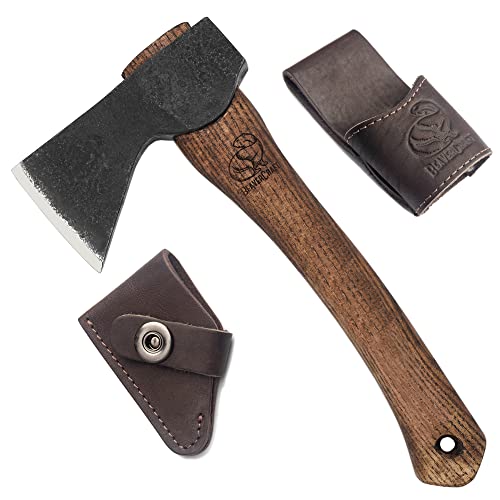
The BeaverCraft AX1 is a compact hatchet for wood carving, bushcraft, camping, and light garden work. Its head uses hardened high-carbon steel, while the handle is made from ashwood. The hand-forged construction gives it a traditional feel, but buyers should expect some variation in finish from one axe to another. At around $80, it costs more than many basic hardware-store hatchets.
Its Scandi grind suits controlled cuts in wood and can also handle chopping, small splitting jobs, and branch trimming. The smaller format should be easier to guide than a full-size forest axe, especially during carving. A cowhide leather sheath covers the edge during storage and includes a belt loop for carrying. The handle and head are fixed together for regular outdoor use, though no axe should be left exposed to rain or stored without checking the handle over time.
Pros
- Hardened high-carbon steel supports repeated carving, chopping, and light splitting.
- Scandi grind gives the edge a useful profile for controlled wood cuts.
- Cowhide sheath and belt loop improve storage and trail carry.
Cons
- The compact head is less suitable for large logs or heavy splitting.
- Around $80 is a high price for a small hatchet, especially if you mainly need basic kindling work.
2. 14.4-Inch Camping Hatchet with Sheath

Best for: Campers splitting small firewood
This compact hatchet measures 14.4 inches from head to handle end. Its 4.2-inch blade and 2.3-pound weight suit camp chores, trail clearing, kindling, and small wood pieces better than heavy timber work. The head uses hand-forged 1065 carbon steel, with quenching and polishing listed as part of its production. At around $37, it offers a practical size for buyers who want one portable chopping tool.
The beech handle has a shaped grip intended to reduce hand strain during longer sessions. Its balance should feel more manageable than a full-size axe, though the compact design also limits leverage. A leather sheath covers the blade for storage and includes a belt loop, so carrying it does not require a backpack. The sheath adds convenience, but users should still secure the tool carefully around children and crowded campsites. The carbon-steel head may also need drying and light oil after wet use to help prevent rust.
Pros
- The 14.4-inch length and 2.3-pound weight make it easier to pack than a full-size axe.
- A 4.2-inch blade handles kindling, small branches, and basic campsite cutting.
- The included leather sheath covers the edge and attaches to a belt.
Cons
- The short handle offers less leverage for large logs or tough, oversized branches.
- At 2.3 pounds, it may feel tiring during repeated chopping or extended wood processing.
1. Purple Dragon Camping Hatchet
Best for: Campers splitting small to medium firewood
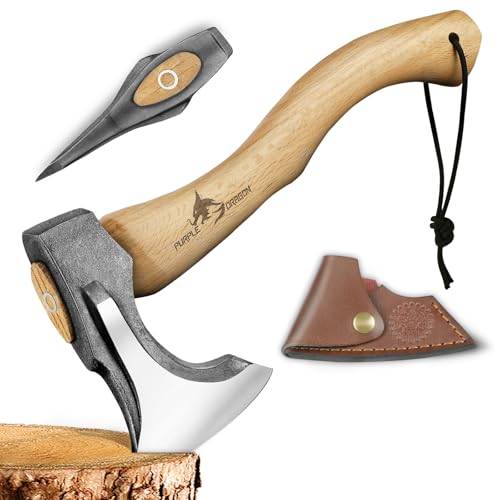
The Purple Dragon is a 14.7-inch hand-forged hatchet for splitting wood, delimbing branches, and basic garden work. Its carbon-manganese steel head has a stated hardness of 56 to 60 HRC. The polished splitting face uses a broad, optimized shape to help the blade enter wood with fewer swings. Two ring wedges secure the head to the hickory handle.
The S-curve handle gives this compact axe a shaped grip and some shock absorption through the wood fibers. A rubber lip protects the cutting edge during storage, while the included hand-stitched leather holster covers the head in a backpack or gear box. Purple Dragon recommends soaking the axe in water for 30 to 60 minutes before use, then wiping it dry. At around $44, it costs more than many basic camping hatchets, but the included cover adds useful value.
Pros
- Compact 14.7-inch size fits camp kits and backpack storage.
- Hickory S-curve handle offers a shaped grip and natural shock absorption.
- Leather holster and rubber edge protection help during transport.
Cons
- The short handle provides less leverage than a full-size splitting axe.
- The soak-before-use instruction adds preparation and requires careful drying to limit moisture exposure.
Buying Guide
The most important factor is head weight matched to your work. A 1.5-pound axe can handle kindling and small limbs, while a 2.5-pound model swings harder but adds noticeable pack weight and fatigue.
-
Head weight: Choose 1.25 to 1.75 pounds for carving, kindling, and camp chores. Pick 2 to 2.5 pounds for splitting larger rounds, if you can carry the extra weight.
-
Handle length: A 16- to 24-inch handle offers a useful balance of control and striking power. Handles under 16 inches pack easily but require more accurate swings.
-
Steel and edge: Look for a clearly stated carbon-steel grade or heat treatment. A 2.5- to 3.5-inch cutting edge suits general camp work, while a thinner edge cuts cleaner for carving.
-
Handle material: Hickory absorbs shock well and can be replaced on many traditional models. Fiberglass handles resist weather, but damage usually means replacing the entire handle.
-
Carry protection: Choose a fitted leather or molded sheath that covers the full edge and secures with a snap or strap. Budget about $60 to $180 for a dependable camp axe, including basic protection.
If you cannot have everything, prioritize a manageable head weight, since control and safe swings matter more than maximum splitting force.
Frequently Asked Questions
How do I choose a bushcraft axe?
Choose a bushcraft axe by matching its weight, handle length, head shape, and steel quality to the tasks you expect. For general camp work, a 1.5 to 2.5-pound head offers enough force for splitting small logs without tiring you quickly. A hickory handle around 24 to 28 inches gives useful control.
What size axe is best for bushcraft and camping?
A 1.5 to 2.5-pound hatchet or axe suits most bushcraft and camping jobs. This range handles kindling, small branches, and modest firewood while staying manageable during repeated cuts. Compact models with 12 to 20-inch handles pack easily, while 24-inch versions provide more leverage for splitting larger pieces.
Can a small hatchet handle most bushcraft tasks?
A small hatchet can handle carving, kindling, shelter notching, and branches up to about 3 inches thick, but it is not ideal for large firewood. Its shorter handle improves control in tight spaces. Choose a longer, heavier axe when you regularly split rounds or cut hardwood logs.
Are carbon steel heads better than stainless steel for bushcraft axes?
Carbon steel heads are usually better for chopping because they are tough, easy to sharpen, and widely available, but they need drying and oiling to resist rust. A stainless head needs less corrosion care, yet many models can be harder to sharpen in the field.
Conclusion
Purple Dragon Camping Hatchet is the top pick for campers and casual bushcrafters who want a compact tool for kindling, shelter work, and light chopping. If your priority is processing thicker rounds or working farther from camp, choose a longer-handled, heavier axe instead, since its added reach and head weight can reduce effort on larger cuts. Before buying, double-check the axe’s overall size, handle material, head weight, sheath compatibility, included quantity, and current price, since listings can change and some bundles show accessories separately. Also consider storage and transport. A small hatchet fits more easily in a pack, while a full-size model needs more room and careful carry. Match the tool to your typical wood and campsite tasks.