
5 Best Jeep Jack for Off-Road Repairs
The VEVOR Farm Jack High-Lift Jack is the best jeep jack for most buyers because its 48-inch lifting range provides useful clearance during tire changes and trail recovery. This steel farm jack also offers a 7,000-pound rated capacity, making it a practical choice for many Jeep models, trucks, and off-road setups. Its tall body can lift higher than a standard bottle jack, though it needs a firm, level contact point.
This guide is for Jeep owners who want a jack for garage repairs, roadside problems, or overland trips. The key factors are lifting height, rated capacity, steel construction, and total weight, since a bulky jack can take up valuable cargo space. The five picks below are ranked with clear reasons and honest drawbacks for each, so you can match the jack to your vehicle and recovery needs.
Quick Comparison
| # | Product | Best For | Price | |
|---|---|---|---|---|
| 1 | VEVOR Farm Jack High-Lift Jack | Muddy farm trucks and fences | ~$80 | View → |
| 2 | XtremepowerUS 48-Inch High Lift Farm Jack | Tall SUVs needing extra lift | ~$90 | View → |
| 3 | Powerbuilt 620471 Unijack Bottle Jack | Stable lifting on uneven driveways | ~$96 | View → |
| 4 | Beaiguna Portable 2-Ton Scissor Car Jack Kit | Compact emergency trunk repairs | ~$26 | View → |
| 5 | Ram 1500 Spare Tire Jack Tool Kit | Ram 1500 roadside tire changes | ~$56 | View → |
5 Top Jeep Jack Picks
This ranked list counts down from fifth place to the top pick, with each Jeep jack matched to a different lifting need.
5. Ram 1500 Spare Tire Jack Tool Kit

Best for: Ram owners needing roadside tire tools
This spare-tire tool kit is made for select Ram and Jeep vehicles, including the 2003–2021 Ram 1500, 2019 Ram 1500 Classic, and 2020–2021 Gladiator. It includes a ratchet wrench and several spare-tire tools for loosening and tightening common nuts and bolts. The listed price is around $56, though it can change over time.
The tools use forged alloy steel with heat treatment for added strength. A polished surface and rust-resistant coating should help the set handle storage in a truck or garage. The wrench openings are calibrated to reduce slipping, but the listing does not provide each tool’s exact size. That missing information makes it harder to compare the kit with your current roadside equipment. It references OE numbers including 5093163AA, 5093510AA, 52014436AA, and 52110301AB, which may help confirm compatibility before ordering. The ratchet design should make spare-tire hardware easier to turn than a basic straight wrench, especially in a tight roadside position.
Pros
- Covers several Ram 1500 model years plus select Gladiator models.
- Heat-treated alloy steel offers a stronger build than basic stamped tools.
- Ratchet wrench can reduce the need to reposition the handle repeatedly.
Cons
- Exact wrench sizes are not listed, so fit should be checked by vehicle and OE number.
- Compatibility is limited to the listed models, rather than being a universal truck kit.
4. Beaiguna Portable 2-Ton Scissor Car Jack Kit

Best for: Trunk-based flat-tire emergencies
The Beaiguna Portable Car Jack Kit is a compact roadside lifting setup for sedans, crossovers, SUVs, and other light vehicles. Its carbon-steel scissor jack supports up to 2 tons, with an adjustment range from 4.33 to 15.75 inches. That range covers many common tire-change situations, but buyers should confirm their vehicle’s weight and factory lift points first. The kit costs around $26, though prices can change.
Its two-way lifting design raises both sides of the mechanism together, while the included ratchet wrench is intended to reduce effort during lifting and lowering. A widened base plate adds more contact with the ground than a narrow foot would provide. The package includes one jack, one ratchet wrench, one lug wrench, two socket pairs, gloves, a pencil-style tire-pressure gauge, and a storage bag. The 17/19 mm and 21/23 mm sockets cover several common lug sizes, but they may not fit every vehicle. The bag also keeps the pieces together in a trunk or garage.
Pros
- 4.33 to 15.75 inches of lift suits many tire-change needs.
- Two-way lifting can raise the jack faster than a single-side design.
- Includes tools, gloves, gauge, and storage bag for roadside use.
Cons
- A 2-ton rating may not suit heavier SUVs, trucks, or loaded vehicles.
- It is a lifting jack, not a substitute for rated jack stands during repairs.
3. Powerbuilt 620471 Unijack Bottle Jack
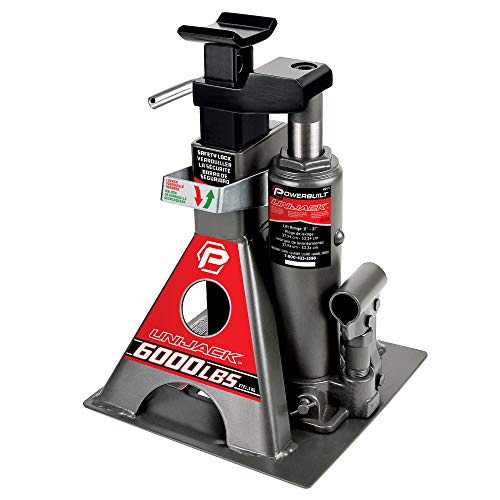
Best for: SUV and truck roadside lifting
The Powerbuilt 620471 combines a bottle jack and jack stand in one compact unit. It lifts vehicles from 11 to 21 inches, a useful range for many pickups, SUVs, vans, Jeeps, and some trailers. A built-in ratcheting safety bar locks the support in place as the vehicle rises, so you do not need to position a separate stand after lifting. The wide base also helps limit sinking on gravel, dirt, or other softer surfaces.
Its one-piece design saves storage space and reduces the number of tools needed for basic roadside or garage work. It can also help level RVs and trailers when used within its rated limits. The listing describes a 3-ton, 6,000-pound capacity, but one feature line states 3,000 pounds. That conflict deserves confirmation before purchase, especially for heavier vehicles. Around $96, it costs more than many basic bottle jacks, but the integrated support adds practical value. Powerbuilt covers it with a 1-year factory warranty and states that it meets or exceeds ANSI standards.
Pros
- Combines lifting and support in one 11-to-21-inch unit.
- Ratcheting safety bar locks the stand at the raised height.
- Wide base offers better support on softer ground and gravel.
Cons
- The listed capacity is inconsistent, showing both 3,000 and 6,000 pounds.
- Its 21-inch maximum height may not suit lifted trucks or high-clearance RVs.
2. XtremepowerUS 48-Inch High Lift Farm Jack
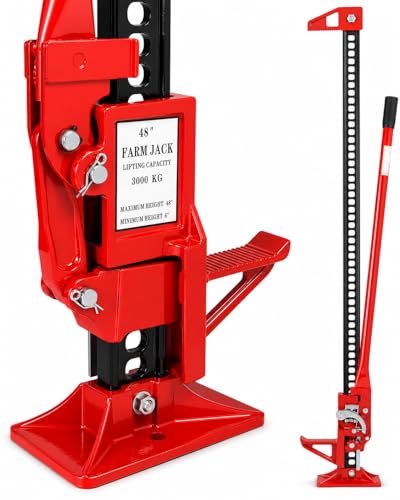
Best for: Off-road owners lifting high-clearance vehicles
The XtremepowerUS 48-inch farm jack is a tall, ratcheting lifting tool for trucks, SUVs, Jeeps, tractors, trailers, and farm equipment. It supports loads up to 6,600 pounds, or 3 tons, with a lifting range from 5.12 inches to 41.14 inches. That reach suits vehicles and equipment that sit too high for a standard floor jack. At around $90, it also costs less than many specialized recovery tools.
Its main advantage is versatility. The jack can lift, pull, clamp, and assist with winching, so it may help with fence posts, stuck vehicles, bumper lifting, and equipment maintenance. A steel frame and powder-coated finish are suited to outdoor work, though the coating will not prevent every scratch or rust spot. The ratcheting mechanism provides controlled movement, while the non-slip handle gives better grip during operation. Users still need a firm base, a suitable lifting point, and jack stands for supported work. This is a mechanical recovery tool, not a complete vehicle-support system.
Pros
- Lifts up to 6,600 pounds, covering many trucks, tractors, SUVs, and trailers.
- The 5.12-inch to 41.14-inch range works with both low and high-clearance equipment.
- Four functions, lifting, pulling, clamping, and winching, add usefulness beyond basic jacking.
Cons
- The 48-inch length requires considerable storage space and may feel awkward to transport.
- Farm jacks need a stable base and compatible lifting points, and they should not support a vehicle alone during repairs.
1. VEVOR Farm Jack High-Lift Jack

Best for: Off-road recovery and farm equipment
The VEVOR Farm Jack is a 48-inch ratcheting jack for trucks, SUVs, tractors, and off-road vehicles. It supports up to 7,000 pounds and lifts from 4.13 to 40.74 inches. That wide range helps with tire changes, bumper lifts, fence posts, stumps, and some recovery work. It can also function as a lateral winch, though buyers should understand the extra setup that task requires.
Its steel parts use casting and stamping, while hot-dip galvanized powder coating helps slow rust and paint wear. The 750 mm handle provides leverage, and the wide base helps limit sinking on firm ground. A 20 mm ratchet hole locks the climbing height, while the wrench switch controls lowering. The rubber-covered handle offers a steadier grip. At around $80, this jack provides more lift range than a typical vehicle jack, but it needs careful placement and regular maintenance. Clean it after use and apply rust-resistant oil to protect the mechanism.
Pros
- 7,000-pound capacity: Handles many trucks, SUVs, tractors, and farm loads.
- 40.74-inch maximum lift: Provides useful clearance for high-riding vehicles and equipment.
- Versatile design: Supports tire changes, off-road recovery, pulling, and lateral stretching.
Cons
- Large 48-inch frame: Takes more storage space than a compact bottle or floor jack.
- Requires stable contact points: Tall farm jacks can become unsafe if placed on soft ground or unsuitable vehicle surfaces.
Buying Guide
The most important factor is lifting capacity. A jack must support your Jeep’s weight with a safe margin, especially during tire changes or underbody repairs.
- Weight rating: Check the Jeep’s GVWR on the driver-door label. Choose a jack rated for at least the vehicle’s full weight, with 3 tons covering many standard SUVs.
- Lift range: Match the minimum and maximum height to your Jeep. A 4 to 6-inch low point suits stock models, while lifted Jeeps may need 20 inches or more.
- Jack type: A floor jack offers stable garage use, while a bottle jack takes less storage space. High-lift models suit some off-road setups but require compatible lift points.
- Base stability: Look for a wide steel base or a floor-jack footprint of roughly 10 by 20 inches. Soft ground may require a separate 12-inch support plate.
- Storage and accessories: Measure your cargo area before buying. A unit under 25 inches long fits more easily, and a carrying handle, padded saddle, or included case adds practical value.
If you cannot have everything, prioritize the correct weight rating and lift range, since portability cannot compensate for an unsuitable or unsafe jack.
Frequently Asked Questions
How high should a Jeep jack lift?
A Jeep jack should lift high enough to raise the tire clear of the ground while keeping its rated capacity above your vehicle’s lifted weight. Check your owner’s manual and measure the suspension range before buying. For many stock Jeeps, a 20- to 24-inch lifting range covers roadside tire changes, but modified vehicles may need more height.
What type of jack works best for Jeep repairs?
A hydraulic floor jack is usually the most practical choice for garage Jeep repairs, while a bottle jack fits tighter spaces and a high-lift jack suits some off-road recovery tasks. Compare models rated at 2 or 3 tons, then choose one that matches your Jeep’s weight and the manufacturer’s lifting-point guidance.
Can a high-lift jack safely lift every Jeep?
No, a high-lift jack cannot safely lift every Jeep, because it needs compatible lifting points, a stable base, and careful operation. Its narrow foot can sink on soft ground, and the handle can move suddenly under load. Use a rated support stand after lifting, and never work beneath a vehicle held only by this type of jack.
Are scissor jacks good for Jeeps?
Scissor jacks are adequate for an emergency tire change in a stock Jeep, but they are not the best choice for repeated repairs or lifted models. They lift slowly and usually offer less clearance than hydraulic options. Keep one rated above your vehicle’s weight, and place it on firm, level ground before raising a wheel.
Conclusion
VEVOR Farm Jack High-Lift Jack is the top recommendation for Jeep owners who need a tall-lift tool for trail repairs, stuck tires, or recovery work. If your priority is a smaller tool for driveway maintenance, pick a hydraulic bottle jack instead, since it stores more easily and usually needs less effort for routine lifting. Before buying, double-check the jack’s size, lift range, weight rating, and compatibility with your Jeep’s lift points. Confirm the quantity if the listing includes accessories or a pair. Check the current price, too, since promotions can change quickly. A farm jack works best with solid mounting points and firm ground, so keep those limits in mind before choosing one.