
6 Best Memory Card for Trail Camera for Long Trips
The INLAND SDHC Memory Card is the best memory card for trail camera for most buyers because it balances storage capacity, recording speed, and price. Its SDHC format fits many standard trail cameras, making it a sensible starting point for routine wildlife photos and short video clips.
This guide is for hunters, landowners, and wildlife watchers who need dependable file storage in remote cameras. Capacity matters most if a camera stays outside for weeks, while write speed and device compatibility affect photo bursts and video recording. The right card should also match the camera’s supported SDHC or SDXC format, since a larger card is not automatically better. The six picks below are ranked with clear reasons and honest drawbacks for each, so you can choose based on your camera, capture settings, and maintenance schedule.
Quick Comparison
| # | Product | Best For | Price | |
|---|---|---|---|---|
| 1 | INLAND SDHC Memory Card | Affordable everyday camera storage | ~$28 | View → |
| 2 | SPYPOINT 32GB Micro SD Memory Card for Trail Cameras | Trail camera owners | ~$27 | View → |
| 3 | SanDisk Ultra SDHC Memory Card | Casual photography storage | ~$20 | View → |
| 4 | GIGASTONE 32GB SDHC Memory Card 5-Pack | Multi-camera memory bundle | ~$66 | View → |
| 5 | SanDisk Extreme PRO SD Memory Card | High-speed burst photography | ~$52 | View → |
| 6 | Trail Camera SD Card Reader | Field photo transfers | ~$10 | View → |
6 Top Memory Cards for Trail Cameras
This list is ranked by capacity, speed, durability, and value, counting down to the top pick for dependable wildlife monitoring.
6. Trail Camera SD Card Reader

Best for: hunters checking SD cards in field
This compact USB-C trail camera reader lets you open photos and videos from a game camera’s SD card on compatible devices. It works with iPhone 15 and newer models, MacBook computers, and Android phones or tablets with USB-C and OTG support. No Wi-Fi connection or separate app is required. Plug in the reader, insert the camera card, and use the device’s file tools to inspect the footage.
Its strongest feature is quick file control at the hunting site. You can view images, play videos, save useful clips, share them, or remove unwanted files without carrying a laptop or waiting to return home. The reader is designed to work with most trail cameras, so it may suit people who use different camera brands. At around $10, it offers an inexpensive way to review a card. Still, USB-C alone does not guarantee Android support. The phone must support OTG, and iPhone compatibility starts with iPhone 15 models and later. This is a simple card-transfer tool, not a cellular or remote-viewing system.
Pros
- Supports iPhone 15 and later, MacBook computers, and compatible Android devices.
- Lets you view, save, share, and delete files directly from the connected device.
- Requires no Wi-Fi or third-party app, which keeps field use simple.
Cons
- Android devices must support OTG, so some USB-C phones and tablets may not work.
- It cannot send trail-camera footage remotely or provide live cellular viewing.
5. SanDisk Extreme PRO SD Memory Card
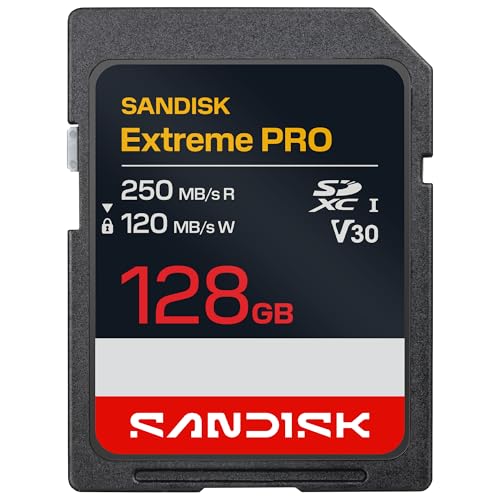
Best for: 4K cameras needing 128GB storage
The SanDisk Extreme PRO is a 128GB UHS-I SD memory card for cameras, camcorders, and other compatible devices. It carries U3 and V30 ratings, which support sustained video speeds for 4K UHD recording. SanDisk lists read speeds up to 250MB/s, though that figure depends on the device, reader, and file type. Around $52, it costs more than basic cards with the same storage.
The larger versions reach 2TB and can hold up to 2,808 minutes of 4K UHD video at 30 frames per second, based on SanDisk’s stated 641MB-per-minute rate. That figure does not apply to this 128GB model, but it shows how the range scales for longer shoots. SanDisk also rates these cards for demanding conditions and repeated handling. The Memory Zone desktop app can help back up, organize, and transfer files through an SD slot or card reader. One key detail matters: the advertised 170MB/s write speed applies to 256GB through 1TB capacities, not this 128GB version.
Pros
- U3 and V30 ratings support 4K UHD video recording.
- Up to 250MB/s read speed can shorten file transfers with compatible hardware.
- SanDisk’s Memory Zone app provides tools for backup, organization, and transfers.
Cons
- The 170MB/s write-speed claim does not cover the 128GB capacity.
- 128GB provides much less recording space than the 256GB, 1TB, and 2TB versions.
4. GIGASTONE 32GB SDHC Memory Card 5-Pack

Best for: Trail cameras needing spare cards
This five-pack includes 32GB full-size SDHC cards for digital cameras, DSLR cameras, camcorders, and compatible trail cameras. Each card measures about 32 by 24 millimeters and uses Class 10, U1 speed ratings. That makes the set suitable for Full HD video recording and playback, plus everyday photos. The listed transfer speed reaches up to 80MB/s, though actual performance depends on the camera, card reader, and files being moved.
The main advantage is the quantity. Five cards let you keep backups ready for several cameras or longer trips. Each one comes with a small storage case, which helps protect loose cards in a camera bag. The cards also have stated resistance to water, temperature changes, shocks, X-rays, and magnets. At around $66 for the pack, the cost works out to roughly $13 per card before price changes. A five-year limited warranty adds some coverage, but warranty terms still depend on the seller and manufacturer.
Pros
- Five 32GB cards provide 160GB of total labeled storage.
- Class 10 and U1 ratings support Full HD video use.
- Individual mini cases protect cards during storage and transport.
Cons
- U1 is not suited to every high-bitrate video format or newer camera feature.
- The pack costs more upfront than buying one 32GB card.
3. SanDisk Ultra SDHC Memory Card

Best for: Everyday cameras and laptop storage
The SanDisk Ultra 32GB SDHC memory card offers a practical amount of removable storage for photos, Full HD video, music, and documents. Its listed transfer speed reaches up to 100MB/s, which can help move files to a computer faster than slower basic cards. That figure usually refers to read speed, so write performance may be lower during continuous shooting or video recording.
Its 32GB capacity suits casual photography and routine file storage, but it leaves less room than 64GB or 128GB cards. The SDHC format also works with many cameras, card readers, laptops, and other devices that support SDHC media. At around $20, it sits in an affordable range for a recognized brand. Still, buyers should check their device manual before ordering. Older hardware may have limits, while newer devices may benefit from a faster card or a larger capacity. This card makes the most sense for everyday use, not demanding professional workflows.
Pros
- Up to 100MB/s read speed can shorten file transfers.
- 32GB holds a useful number of photos and shorter video clips.
- SDHC format works with many cameras, computers, and card readers.
Cons
- 32GB fills faster than 64GB or 128GB cards, especially with high-resolution video.
- The advertised 100MB/s speed may describe reading, not sustained writing during burst photos or video recording.
2. SPYPOINT 32GB Micro SD Memory Card for Trail Cameras

Best for: Hunters rotating cards in trail cameras
The SPYPOINT 32GB Micro SD card is made for trail and game cameras that use removable storage. Its 32GB capacity provides space for photos and video before the card needs to be changed. The included adapter helps it work with devices that accept a standard SD card. Class 10 speed also gives it a suitable baseline for routine camera recording and file transfers.
What sets this card apart is its focus on outdoor camera use. It is designed to remain in hunting cameras for months in wooded locations and other less-than-ideal conditions. It should work with a wide range of cameras that have an SD card slot, although buyers should still confirm their camera’s supported card type and capacity. Around $27, it costs more than many basic 32GB memory cards, but the camera-focused design may appeal to users who prefer a purpose-built option.
Pros
- 32GB capacity holds a useful amount of photos and video.
- Class 10 speed supports regular trail-camera recording and transfers.
- SD adapter adds compatibility with standard card slots.
Cons
- High-trigger cameras or video settings can fill 32GB quickly.
- Around $27, it may cost more than generic 32GB cards.
1. INLAND SDHC Memory Card
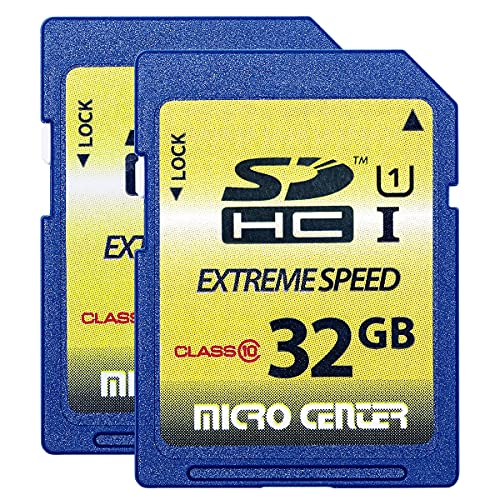
Best for: Cameras needing spare storage
The INLAND 32GB SDHC card pack includes two full-size SD cards, giving you 64GB of combined capacity. Each card uses the standard SD shape, so it fits many digital cameras, camcorders, and other SDHC-compatible devices. Around $28, this two-pack can cost less than buying separate cards, though prices change over time. These are not microSD cards, and their physical size prevents use in most mobile phones without a suitable adapter.
The cards list read speeds up to 60MB/s and write speeds up to 10MB/s. That makes them suitable for everyday photo transfers and full HD video recording, with a Class 10 rating for consistent video capture. The 10MB/s write rate is modest, so photographers shooting long bursts may notice slower clearing than they would with faster cards. Each card has rugged construction and includes a three-year limited warranty. Compatibility needs careful checking. The host device must support SDHC or SDXC, since older SD-only equipment will not recognize these cards.
Pros
- Two 32GB cards provide 64GB of total storage.
- Class 10 performance supports full HD video recording.
- Three-year limited warranty adds coverage for defects.
Cons
- SDHC-only compatibility excludes older SD host devices.
- The full-size design does not fit mobile phones directly, and the 10MB/s write speed may limit burst shooting.
Buying Guide
The most important factor is compatibility with the camera’s card format and capacity limit. A card that does not support the required SD or microSD size, file system, or maximum capacity may fail to record, regardless of its speed or price.
- Card type: Confirm whether the unit takes full-size SD, microSD, or microSD with an adapter. Do not assume both formats fit the same camera.
- Capacity: Match the manufacturer’s limit. Choose 32GB for older models, or 64GB to 128GB only when the camera specifically supports larger cards.
- Speed rating: Class 10 or U1 is enough for most trail-camera photos and standard video. U3 ratings rarely improve performance in basic wildlife cameras.
- Endurance: Choose a high-endurance card rated for security cameras or continuous writing. This suits cameras that capture hundreds of photos or several video clips each day.
- Weather tolerance: Look for operating temperatures around -13°F to 185°F, plus water, shock, and X-ray resistance. Replace cards that show errors or corrupted files.
- File system and care: Cards up to 32GB commonly use FAT32, while larger cards often use exFAT. Format the card inside the camera before placing it outdoors, and carry a spare.
If you cannot have everything, prioritize confirmed camera compatibility over capacity, speed, or price.
Frequently Asked Questions
What size memory card works best for a trail camera?
A 32GB or 64GB card suits most trail cameras, with 32GB enough for short visits and 64GB better for longer deployments. Choose the camera’s supported capacity first, since some models accept only 32GB or 64GB cards. A 64GB card can hold thousands of low-resolution photos, but video fills it faster.
How fast should a memory card be for a trail camera?
A Class 10, U1 microSD card is fast enough for most trail cameras, while U3 helps models that record high-bitrate video. Speed class matters less than compatibility and endurance. For example, a card rated at 10MB/s sustained write speed meets the basic Class 10 standard, but check the camera manual first.
Can I use a 128GB card in a wildlife camera?
You can use a 128GB card only when the camera explicitly supports that capacity and format. Many older trail cameras accept 32GB or 64GB cards, and larger cards may fail to format or record. Check the manual before buying, then format the card inside the camera after installation.
Are high-endurance cards worth buying for trail cameras?
High-endurance cards are worth buying for trail cameras that capture frequent photos or daily video, because they handle repeated write cycles better than standard cards. A camera taking 200 photos per day can write more than 73,000 files yearly. Replace damaged or unreliable cards quickly, since missed footage cannot be recovered.
Conclusion
INLAND SDHC Memory Card is the top pick for trail-camera owners who want simple, dependable storage for routine photo and video capture. If your priority is leaving a camera in the field for weeks or recording frequent video, choose a higher-capacity, high-endurance card instead, since extra storage can reduce card changes and endurance suits repeated write cycles. Before buying, double-check the storage size, your camera’s supported capacity and format, the number of cards included, and the current price, since listings can change. Also confirm whether the package includes a full-size SD card or only a microSD card with an adapter. A small mismatch can leave you with a card the camera cannot read.